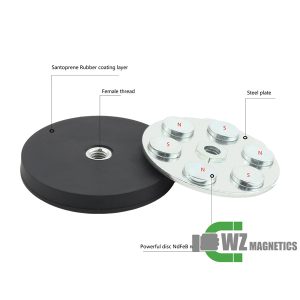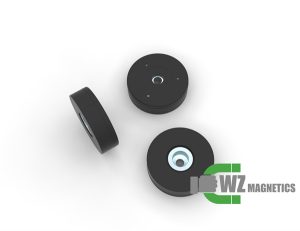
The manufacturing process of rubber coated magnets begins with assembling permanent magnets and steel components into specially designed magnetic circuits. This design maximizes the magnetic force and enhances the holding power of the magnets. The key stage in this process is the application of the rubber coating, accomplished primarily through vulcanization molding or injection molding, both of which require precise molds to ensure an even coating.

Vulcanization molding is a chemical technique that strengthens rubber by adding sulfur or similar curing agents, which induce cross-linking between polymer chains. This cross-linking increases the material’s rigidity and durability, while also altering its mechanical and electrical properties. This method, which typically uses NBR or EPDM rubber, involves specific pressures and temperatures to achieve the desired characteristics and is usually irreversible.
Alternatively, the rubber coating can be applied using injection molding. Unlike vulcanization, which is specific to rubber, injection molding is a common method for shaping plastics. Weizhong Magnetics employs TPV for their rubber coatings. TPV, or thermoplastic vulcanizates, belong to the thermoplastic elastomer family, displaying properties akin to vulcanized rubber while being processable like thermoplastics. TPV consists of a blend of fully cured EPDM rubber particles embedded in a polypropylene matrix.
TPV is chosen for its long-term durability, aesthetic finish, and its capability to be fully recycled during the manufacturing process, making it a sustainable choice for rubber coated magnets .